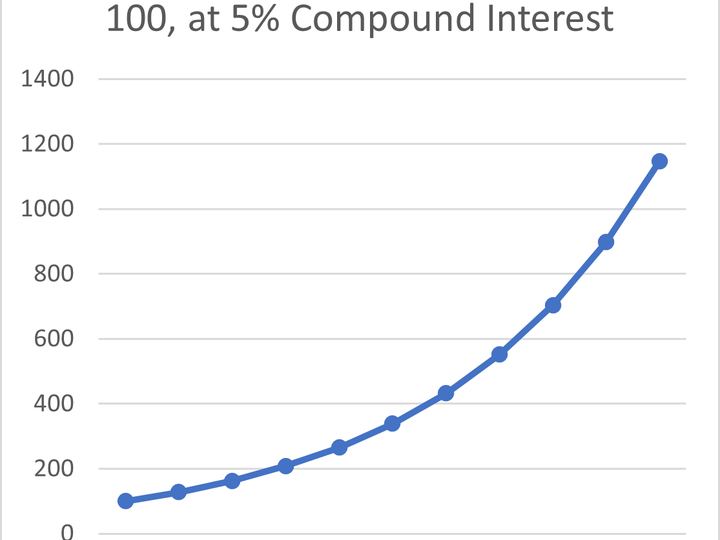
Compound Interest Explained
Interest that earns its own interest. Compound interest means earning returns on past returns. See how time, rate and patience turn small sums into large ones, and why debt compounds too.
Stacks of coins: Kevin Schneider, CC0
Simple versus compound
With simple interest you earn a return only on your original amount. Put $1,000 somewhere paying 7 percent simple interest and you get $70 every year. After 30 years you would have $3,100.
With compound interest, each year's earnings are added to the balance, and next year's interest is calculated on the bigger number. The same $1,000 at 7 percent compounded yearly grows to about $1,967 after 10 years, about $3,870 after 20 years and about $7,612 after 30 years. Same rate, same starting money, more than twice the result.
Video: Compound interest introduction | Interest and debt | Finance & Capital Markets | Khan Academy (Khan Academy), embedded from YouTube.
The formula, decoded
The standard formula is A = P(1 + r/n)^(nt). P is the starting principal, r is the annual rate as a decimal, n is how many times per year interest is added and t is the number of years. A is what you end up with.
More frequent compounding helps a little, but the two variables that matter most are the rate and, above all, time. Because growth builds on itself, the last decade of a long stretch often adds more dollars than the first two decades combined.
Why starting early matters
Imagine two savers earning the same return. One starts at 25 and the other at 35, and both stop at 65. Even if the late starter saves somewhat more each year, the early starter often ends up ahead, because the first dollars had ten extra years to multiply. Time is the one ingredient you cannot buy back.
Regular contributions supercharge the effect, since every new deposit starts its own compounding clock.
Reinvesting matters too. Dividends or interest that are spent instead of reinvested stop compounding, so the habit of letting earnings stay put can make a big difference over decades.
The dark side: compounding debt
Compounding is neutral. On a credit card that charges a high annual rate, unpaid interest is added to your balance and then charged interest itself. Carrying a balance month after month can make a modest purchase far more expensive than its sticker price, which is why many people prioritize paying off high-interest debt.
Real returns on investments vary from year to year and can be negative, and fees reduce what compounds. Not financial advice: this page is general education, not a recommendation for your personal situation. Talk to a licensed professional before making money decisions.
- Khan Academy (YouTube): Compound interest introduction
- Calculator Soup: Compound Interest Calculator
- Cuemath: Compound Interest, definition, formulas and examples
Facts on this page were checked against these sources.
- Stacks of coins: Kevin Schneider, CC0
Text written by Biggest Bossman.